


Poodle Coloring
Poodles might have the most diverse palette of colors available in a single dog breed. Take a look for some examples and to learn the descriptive terminology.
Color: What Matters Most?
Color is one of the first things people notice about a puppy, and it's perfectly normal to have a favorite. However, after years of watching puppies grow up with their families, I've learned that temperament, trainability, health, and lifestyle fit have a much greater impact on long-term happiness than color.
The color of your Poodle won't determine whether they become an amazing hiking partner, boating buddy, therapy prospect, travel companion, or family dog. Those qualities come from temperament, training, and the relationship you build together.
My advice? Have a favorite color, but keep an open mind. The puppy that steals your heart may not be the color you originally imagined.
What Colors Do We Typically Produce?
We commonly produce puppies with black, brown, and apricot/red base coats. These base coat colors can also have variations such as abstract markings, parti, phantom, and/or merle.
Poodle Colors and Patterns
Parti
Parti refers to a white coat with patches of another color, such as black or brown. Parti Poodles can also carry phantom markings and/or merle patterning, creating a wide variety of unique color combinations. Some parti dogs develop ticking, which appears as small flecks of color in the white portions of the coat. These flecks usually become more noticeable as the dog grows older.


Abstract
Abstract markings are usually small white patches on the chest and possibly the feet. They can also be called "mismarks." Abstract markings can be found with solid, phantom, or merle colored Poodles. Genetically speaking, it means the dog carries 1 copy of the parti color gene.


Phantom
Phantom Poodles have a base color with defined markings of a second color appearing above each eye, the sides of the muzzle, the fore chest, under the tail, and the base of the feet/legs. Phantom coloring can be found on solid Poodles or in conjunction with parti, or merle coloring.


Merle
Merle is a pattern that creates patches of lighter color throughout the coat, giving a marbled or mottled appearance. The merle gene affects random sections of the coat, causing them to be diluted. For example, a black-based merle will have areas of black and gray and is often called a blue merle. A brown-based merle will have areas of rich brown mixed with lighter brown. Because the pattern is random, every merle Poodle is unique.
Merle is caused by a dominant gene, meaning a dog only needs one copy of the merle gene to display the pattern.


Health Considerations
There are some common misconceptions about merle coloring. A Poodle with a single copy of the merle gene is not inherently less healthy than a non-merle Poodle. The health concerns associated with merle arise when two merle dogs are bred together. In that situation, some puppies may inherit two copies of the merle gene and become what are known as double merles. Double merles have an increased risk of vision and hearing impairments, which is why responsible breeders avoid merle-to-merle breedings.
Merle and the Breed Standard
Another common misconception is that a merle Poodle cannot be AKC registered. If both parents are AKC registered, a merle puppy can also be registered. However, merle is not considered a breed-standard color for AKC conformation competition. Interestingly, phantom, parti, and abstract markings are also outside the AKC conformation color standard.
For most pet owners, this distinction has very little impact on everyday life. The purpose of a conformation show is to evaluate how closely a dog matches the written breed standard. Being an off-standard color does not mean a dog is unhealthy, poorly bred, or less capable as a companion. It simply means the dog's color does not meet the qualifications for the AKC conformation show ring.
As with any color preference, my advice is to enjoy the colors you love while remembering that temperament, trainability, health, and lifestyle fit will have a much greater impact on your experience with your dog than coat color ever will.
Fading
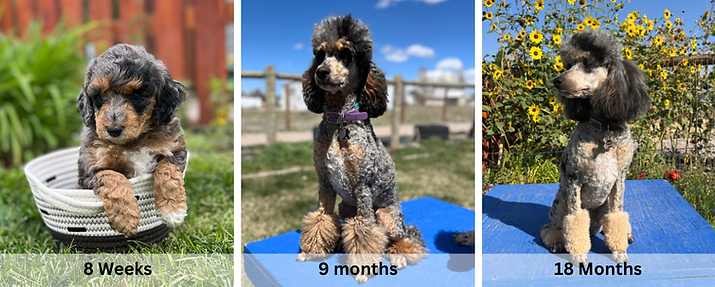
Will your Poodle puppy change colors as it grows?
Many Poodles experience some degree of fading, also called progressive graying, as they mature. In fact, the puppy stage is often when Poodles are at their most vibrant and richly colored. As they grow and develop their adult coat, some colors may lighten over time.
Several recognized Poodle colors are the result of this fading process. A blue Poodle is born black and gradually lightens during the first 1-2 years of life. A silver Poodle is also born black but fades much more dramatically, often beginning in the first few months. Similarly, café au lait and silver beige begin as darker shades of brown and gradually lighten as the dog matures.
Color change is simply one of the many genetic traits found within the Poodle breed. Like all living things, dogs experience naturally occurring genetic mutations over time. Some mutations are undesirable, while others create traits that people enjoy and embrace. The fading trait is one example that has become an accepted and even celebrated part of the breed, as evidenced by colors such as blue, silver, café au lait, and silver beige being recognized in the AKC breed standard.
You can see in this puppy that the phantom points faded from a dark copper to a lighter copper after she turned 1 year old. The phantom points are still very noticeable, but the color is not as deep. The merle coloring of her body has not changed. Interestingly I see less fading and color change in merle Poodles. Maggie is from Ivy's "Ice Cream" litter.
Can Genetic Testing Predict Fading?
This is where things get interesting. You may encounter breeders who advertise that their puppies will not fade. They may reference "intensity" scores or point out that their dogs do not carry the dilution gene. While those genetic markers provide useful information, they do not currently predict progressive graying in Poodles.
At this time, the genetic cause of fading has not been fully identified, which means there is no DNA test available that can accurately predict whether a puppy will fade or how much color change might occur over time.

This is Boone. You can see that his puppy coat in the first two pictures had a darker color than his 2 year old picture with his adult coat. The zoomed in picture on the far right shows you the small white hairs mixed in with the brown. They are sometimes called "guard hairs." The integration of these lighter hairs with the brown hairs is what causes the overall intensity of color to fade as they mature.
How Can You Estimate Adult Color
The best tool available is surprisingly simple: look at the adult dogs.
When evaluating a puppy, pay close attention to the sire, dam, and other relatives that are at least 18-24 months old and have developed their adult coats. Their appearance often provides the best clues about what colors may be present in a puppy's genetic background.
Summary
Some breeders capitalize on colors. That isn't my goal. A puppy's color may catch your eye, but its temperament, trainability, and companionship are what will capture your heart for years to come. Choose the dog that best fits your lifestyle, and if it also happens to be your favorite color, that's icing on the cake.